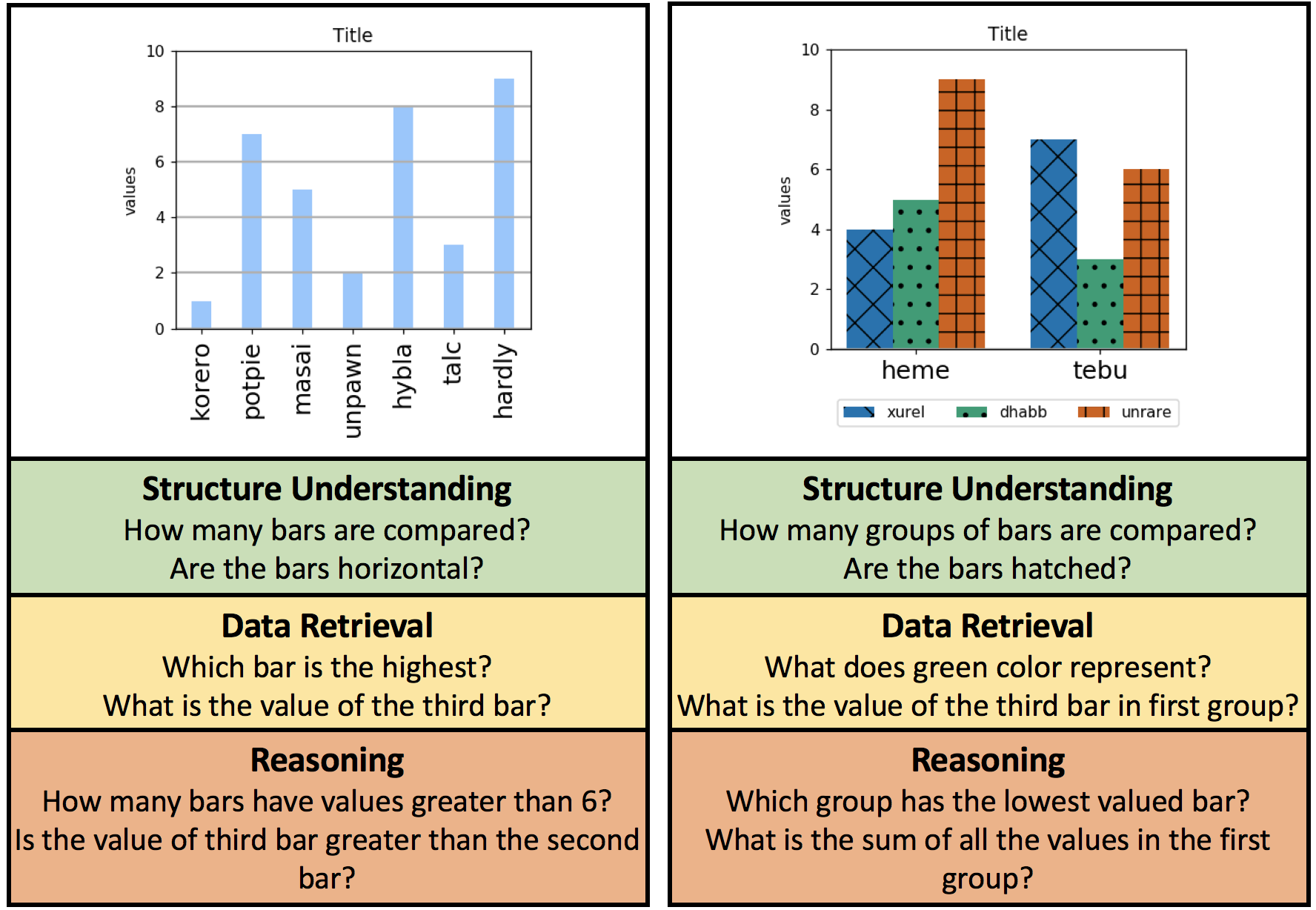
Data visualizations, e.g., bar charts, pie charts, and plots, contain large amounts of information in a concise format. These visualizations are designed to communicate data to people, not to be machine interpretable. Nevertheless, making algorithms capable of making inferences from data visualizations has enormous practical applications. Here, we study systems capable of answering open-ended questions about bar charts, which we refer to as data visualization question answering (DVQA). DVQA would enable vast repositories of charts within scientific documents, web pages, and business reports to be queried automatically.
Unlike visual question answering (VQA), DVQA requires processing words and answers that are unique to a particular bar chart. State-of-the-art VQA algorithms perform poorly on DVQA, and we propose two strong baselines that perform considerably better. Besides practical benefits, DVQA also serves as an important proxy task for several critical AI abilities, such as attention, working memory, visual reasoning, and the ability to handle dynamic and out-of-vocabulary (OOV) labels.
DVQA at a glance
- 3 question types assessing structure understanding, data retrieval, and reasoning
- 300,000 images with large variation in both data and bar-chart appearance
- 3,487,194 question-answer pairs balanced to remove simple language biases
- Detailed metadata for every element in each chart